Showing posts with label Crete. Show all posts

Friday, July 11, 2008

Greece responds to critics of culture polcy


I have read dozens of books about ancient Greece by such authors as Mary Renault, Steven Pressfield, and Michael Curtis Ford as well as listened to every course on ancient Greece and Greek culture I can get my hands on from The Teaching Company. I've also been fascinated by the Minoan culture and admired their beautiful art for years, too.

So I have been yearning to visit Greece for quite some time. But I had been cautioned by friends who had visited Greece that the ancient sites there were in pretty bad condition. However, I had once more considered traveling to Greece after viewing images of the beautiful new museum near the Acropolis in a recent television program. But, I was surprised to read in this article that Greece has continued to be less than hospitable to tourists, once the Olympic Games "gold rush" ended.

Apparently, though, frustrated tourists and tour operators have been badgering the Greek government trying to get them to wake up to the opportunities offered by a healthy tourism industry and they have finally responded by hiring more staff and extending some site hours for at least part of the year.

The additional staffing and extended opening hours are welcome but I agree with the individual that pointed out most tourists would rather visit these sites in the off-season not during the blistering summer months - me included. But, it's a start.

The article also mentioned that the Museum of Heraklion is closed until 2010 for rennovations. I would want to be sure it was reopened before I planned a visit as I gather Crete tours can be arranged with Athens tour operators. So, maybe a 2011 visit may be more prudent for me.

"Extra staff have been dispatched to guard the great cultural gems of Greece as the government in Athens tries to deflect growing criticism of its handling of national treasures.

Amid unprecedented protests from tour guides, travel companies and tourists irritated by conditions at prime archaeological sites, the ruling conservatives last week rushed hundreds of additional personnel to staff museums and open-air antiquities.

"The situation at museums and sites around the country is bad," the culture minister, Michalis Liapis, conceded in parliament last week. "It has to be corrected."

The move follows embarrassing revelations over the upkeep of Greece's ancient wonders and mounting public disquiet, voiced mostly by foreigners in the local press, over visitor access to them.

Yesterday, the authoritative newspaper Sunday Vima disclosed that the Cycladic isle of Delos - the site of Apollo's mythological sanctuary and one of Greece's most important ancient venues - resembled an "archaeological rubbish dump". Recently, it emerged that many sites, including Delphi, Mycenae and the spectacular Bronze Age settlement of Akrotiri on the popular island of Santorini, were only partially open or permanently closed."

If you enjoyed this post, never miss out on future posts by following me by email!

Sunday, March 16, 2008

Fault Near Crete Said To Be Responsible for 365 CE Quake

Tsunamis like the the one that devastated ancient Alexandria in A.D. 365 may hit the Mediterranean relatively often, a new study argues. Scientists say they have pinpointed the geological fault—off the coast of the Greek island of Crete—that likely slipped during a huge quake and caused the ancient tsunami.

Massive earthquakes—greater than magnitude 8—may strike the Mediterranean roughly every 800 years, the research suggests.

But other scientists say that not enough is known about these faults to predict how often such quakes might strike. They argue that the 365 disaster may have been unique.

The authors of the new study measured the remains of corals, algae, and other sea life that run in a band along the coast of Crete.

"The ancient shoreline resembles a bathtub ring high above the sea on the cliff face," said Beth Shaw of the University of Cambridge in England, lead author of the study.

The findings, published in Nature Geoscience, fix a date to when western Crete was suddenly lifted up, strengthening the tie between this event and the tsunami (see a map of Crete).

The team narrowed down the date of the uplift to within a few decades of 365, bolstering the idea that the upward shift happened in one sudden jolt.

"Ten meters [33 feet] of uplift is quite astonishing," Shaw said. "Unexpectedly, our results confirm that all [of the] uplift did happen in the 365 A.D. earthquake."

If you enjoyed this post, never miss out on future posts by following me by email!

Friday, March 14, 2008

Minoan Exhibit On Display at the Onassis Culture Center


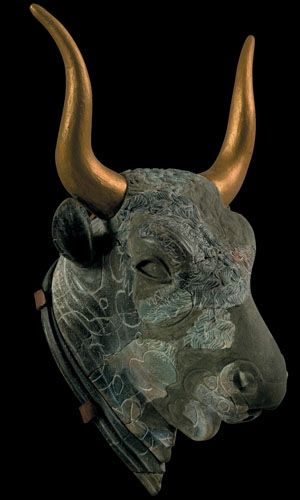
I wish I could get to New York this summer and see this fascinating exhibit of Minoan artifacts at the Onassis Culture Center. The Minoan civilization has intrigued me all my life and I'm always excited to see Minoan art. I hope to visit Crete in the next few years and see the ruins in person. A friend of mine pointed out that much of the sites you visit in Crete are mostly reproductions but I can't help but long to see them anyway. I found this Late Minoan 1B (ca. 1450 BCE) carved chlorite bull's head with gilded horns from Zakros exquisite!

"An important new exhibition, From the Land of the Labyrinth: Minoan Crete, 3000-1100 B.C., has just opened at the Onassis Cultural Center in New York. It brings more than 280 artifacts from Crete--from a miniature gold double-ax to a four-foot-tall storage jar, from wall paintings to carbonized figs--most of which have never been shown abroad before and some being displayed for the first time ever. On loan from the archaeological museums of Herakleion, Khania, Rethymnon, Haghios Nikolaos, Ierapetra, Siteia, and Kissamos in Crete, the artifacts are arranged in 11 thematic sections intended "to reveal aspects of daily life in the Minoan civilization--including social structure, communications, bureaucratic organization, religion and technology--during the third and second millennia B.C." The first solely Minoan exhibition in the United States, From the Land of the Labyrinth is a great overview of the civilization and its achievements.

Some of the small terracotta figurines on display have a seemingly playful character, such as double-headed (push me, pull you) bull and a rather large dung beetle. But the bull is a votive offering from Vrysinas, a mountaintop sanctuary, and many two-headed bulls were found there. (The exhibition catalog notes that by adding a second head, the donor of the votive might have emphasized the importance of the request being made to the divinity.) The beetle, from the open-air sanctuary of Piskokephalo, is another votive and recalls the Egyptian scarab.

Two of the most intriguing finds on display are sistra, Egyptian rattles, found at excavations on Crete. One, made of bronze and found at Mochlos, is dated about 1450. The other is one of six terracotta ones that accompanied burials in a cave at Hagios Charalampos that are substantially earlier, ca. 2100-1700 B.C. The exhibition catalog notes that "the sistra constitute undeniable evidence for a strong relationship between Crete and Egypt and of the influences exerted by Egypt on Minoan civilization." Other reminders of links between the Minoans and Egypt in the exhibition include the beetle votive figurine already mentioned and a scarab of the 18th Dynasty pharaoh Amenhotep III from Kastelli, Khania.

A highlight is the well-preserved boars' tusk helmet from Armenoi, only the second such helmet found in Crete. Shown alongside it are two miniature representations of men wearing boars' tusk helmets. Both of these (one of hippo ivory and one of bone) would have been attached to a furnishing of some sort. All three date within 1375-1250 B.C. In an adjacent case is a large Late Minoan II (1450-1400 B.C.) jar on which boars' tusk helmets are used as the chief decorative motif. So, we have the full range of actual object, use of the object as a decorative plaque, and reduction of it to a motif that perhaps conveyed a sense of prestige.

If you enjoyed this post, never miss out on future posts by following me by email!

Thursday, June 14, 2007

Image of Labyrinth found in Bulgarian tomb


Bulgarian archaeologists have found an image of the legendary labyrinth of King Minos, the Bulgarian National Radio reported.

The exclusive find was unearthed near the village of Golyam Derven last week.

The team of Professor Daniela Agre, who are doing excavation works in the area, stumbled upon the unique artefact while researching a an ancient Thracian tomb's entrance stone.

The labyrinth image, which is carved on the slate, is perfectly preserved.

The legendary labyrinth was considered a just a myth from the Greek mythology until the exclusive finding. According to the legends, King Minos ordered the construction of the labyrinth to keep inside the monstrous Minotaur.
If you enjoyed this post, never miss out on future posts by following me by email!