Showing posts with label Onassis Culture Center. Show all posts

Thursday, December 25, 2008

Onassis Cultural Center to host Worshiping Women: Ritual and Reality in Classical Athens


I really need to plan a visit to the Onassis Cultural Center in New York. I wanted to see the exhibit about life in Sparta they hosted a couple of years ago but the Historical Novel Society conference I attended in Albany was scheduled too late. I'm afraid I won't get to see this excellent exhibit either as I'll be just back from Rome in March and would not have enough "recovery" time to turn around and attempt another trip to New York so soon.

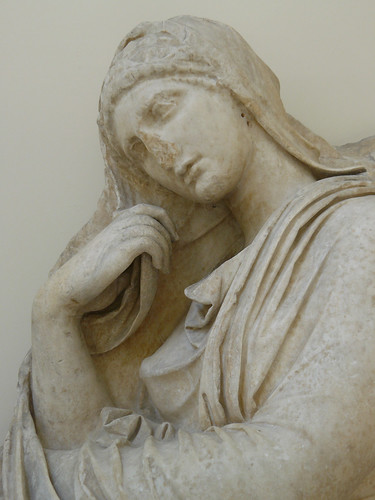
[Image - Although this sculpture of a mid-4th century BCE Attic woman from Acharnae Menidi discovered before 1827 is part of the permanent collection of the Metropolitan Museum of Art and is not part of the upcoming exhibit, it typifies the subtle grace and modesty depicted in sculpture of the period. This image is included in my Flickr image archive. I have licensed all images with Creative Commons for free non-commercial use with the attribution "Photo by Mary Harrsch". Any derivatives must also be shared in like manner]

The galleries of the Onassis Cultural Center in New York will be transformed into evocations of ancient Greek sanctuaries, each filled with artistic masterpieces assembled from international collections, for the major exhibition Worshiping Women: Ritual and Reality in Classical Athens. On view from December 10, 2008, through May 9, 2009, the exhibition brings together 155 rare and extraordinary archaeological objects in order to re-examine preconceptions about the exclusion of women from public life in ancient Athens. The story told by these objects, and experienced in the galleries, presents a more nuanced picture than is often seen, showing how women’s participation in cults and festivals contributed not only to personal fulfillment in Classical Greece but also to civic identity.

Among the treasures being brought to New York for the exhibition are marble statues of the goddesses Artemis and Athena (National Archaeological Museum, Athens); a white-ground vase with an image of Artemis, by the Pan Painter (State Hermitage Museum, Petersburg); a red-figure vase with an image of Iphigenia, the legendary heroine worshiped as a cult figure and seen as a model for priestesses (Museo Archeologico Nazionale, Ferrara); a vase showing the Trojan priestess Theano, another model for priestesses, receiving the Greek warriors who had come to recover Helen from Troy (Vatican Museums); and a limestone grave marker (conserved with support from the Onassis Foundation) carved with the image of a young woman in bridal costume, holding a votive offering (State Museums of Berlin). Interspersed with these and other exquisite artworks are archaeological objects that document the religious practices of Classical Athens and tell the complex story of women’s roles in that society.

Worshiping Women tells this story in three main chapters. “Goddesses and Heroines” introduces the principal female deities of Athens and Attica, in whose cults and festivals women were most actively engaged: Athena, Artemis, Aphrodite, and Demeter and her daughter Persephone. This first section also investigates the role of heroines, a special group of women believed to have lived in the distant past, who like Iphigenia became important figures of cult worship after their deaths.

The second chapter, “Women and Ritual,” explores the practice of ritual acts such as dances, libations, sacrifices, processions and festivals in which women were active in classical antiquity. Here the critical role of the priestess comes to light, specifically in her function as key-bearer for the temples of the gods.

In the final chapter, “Women and the Cycle of Life,” the exhibition explores how religious rituals defined moments of transition. Because the most important transition in a girl’s life was understood to be marriage, the wedding took on great significance, with its rituals depicted on a variety of vases associated with nuptial rites and wedding banquets. Death was another occasion on which Athenian women took on major responsibilities, such as preparing the deceased for burial and tending the graves of family members.

N.S. Gill's post about the exhibit in her "About Ancient History" blog included a link to a fascinating article about the ancient festival of Thesmophoria. An abstract:

Before the Thesmophoria festival itself, there was a preparatory night-time festival called the Stenia. At the Stenia women engaged in Aiskhrologia, insulting each other and using foul language. This commemorated Iambe's successful attempts to make the grieving mother Demeter laugh.

[This almost sounds like modern antics associated with male bonding!]

During the Stenia portion of the Thesmophoria women may have placed fertility objects, molded bread [in the shape of male genitals], pine cones and piglets, in a snake-filled chamber called a megaron.

The objects were later retrieved and ceremonially carried to an altar during a night time torch-lit procession commemorating Demeter's search for her kidnapped daughter Persephone. Aristophanes' comedic play Thesmophoriazusae tells the story of a man trying to infiltrate the Thesmophoria. Maybe Clodius of Roman fame got his idea to sneak into the celebration of the Bona Dea and seduce Julius Caesar's wife after reading the Thesmophoriazusae!

If you enjoyed this post, never miss out on future posts by following me by email!

Sunday, November 02, 2008

Hotel construction halted after survey shows ancient Susa perimeter three times as big as originally thought

http://www.livius.org/a/1/iran/susa_apadana2.JPGThe construction of Laleh and Amir Zargar hotels began following authorization of the project by the Khuzestan Cultural Heritage, Tourism and Handicrafts Department (KCHTHD) in 2007.

However, the projects were halted after cultural heritage enthusiasts caused a media frenzy and in early September 2008, Shush Cultural Heritage Center (SCHC) director Mohammadreza Chitsaz said that the project had been banned following a series of expert investigations.

Meanwhile, a deputy director of the Cultural Heritage, Tourism and Handicrafts Organization (CHTHO) said in mid October that there are no obstacles to the construction of the hotels.

A team led by Mohammad-Taqi Ataii made 61 excavations at Susa and determined a 1200-hectare perimeter for the city as 32 of the digs have resulted in identification of ancient strata.

The previous demarcation, which had been carried out decades before, determined a 400-hectare perimeter for Susa.

Susa consists of many satellite suburbs, villages, and workshops said Boucharlat, adding that the city is not limited to the 400-hectare perimeter.

It most likely that there are many ancient sites and artifacts in the area, which should be safeguarded by Iranian cultural officials, Boucharlat said.

Susa was an ancient city in the Elamite, Persian, and Parthian empires of Iran, located about 150 miles east of the Tigris River in Khuzestan Province of Iran.

Susa is one of the oldest known settlements in the region, probably founded around 4000 BC, although the first traces of an inhabited settlement date back to 7000 BC. - More - Tehran Times

Technorati Tags: , , , , , , ,
If you enjoyed this post, never miss out on future posts by following me by email!

Wednesday, April 02, 2008

Parthian Jar Burial Found in Iran


"Iranian archeologists have found the jar burial of a Parthian girl during the first phase of excavations in Nakhl-e Ebrahim village.

The eight-year-old girl was buried 2200 years ago along with 18 objects including, agate jewelry, beads and earthenware.

Earlier, a Parthian castle was discovered in the area, which was announced to be the largest fortress found on the Persian Gulf shore.

The items from Nakhl-e Ebrahimi village, located near the Strait of Hormuz in southern Iran, have been displayed by Iran's Cultural Heritage, Tourism and Handicrafts Organization."
If you enjoyed this post, never miss out on future posts by following me by email!

Friday, March 14, 2008

Minoan Exhibit On Display at the Onassis Culture Center


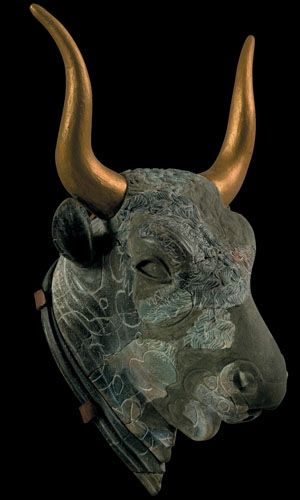
I wish I could get to New York this summer and see this fascinating exhibit of Minoan artifacts at the Onassis Culture Center. The Minoan civilization has intrigued me all my life and I'm always excited to see Minoan art. I hope to visit Crete in the next few years and see the ruins in person. A friend of mine pointed out that much of the sites you visit in Crete are mostly reproductions but I can't help but long to see them anyway. I found this Late Minoan 1B (ca. 1450 BCE) carved chlorite bull's head with gilded horns from Zakros exquisite!

"An important new exhibition, From the Land of the Labyrinth: Minoan Crete, 3000-1100 B.C., has just opened at the Onassis Cultural Center in New York. It brings more than 280 artifacts from Crete--from a miniature gold double-ax to a four-foot-tall storage jar, from wall paintings to carbonized figs--most of which have never been shown abroad before and some being displayed for the first time ever. On loan from the archaeological museums of Herakleion, Khania, Rethymnon, Haghios Nikolaos, Ierapetra, Siteia, and Kissamos in Crete, the artifacts are arranged in 11 thematic sections intended "to reveal aspects of daily life in the Minoan civilization--including social structure, communications, bureaucratic organization, religion and technology--during the third and second millennia B.C." The first solely Minoan exhibition in the United States, From the Land of the Labyrinth is a great overview of the civilization and its achievements.

Some of the small terracotta figurines on display have a seemingly playful character, such as double-headed (push me, pull you) bull and a rather large dung beetle. But the bull is a votive offering from Vrysinas, a mountaintop sanctuary, and many two-headed bulls were found there. (The exhibition catalog notes that by adding a second head, the donor of the votive might have emphasized the importance of the request being made to the divinity.) The beetle, from the open-air sanctuary of Piskokephalo, is another votive and recalls the Egyptian scarab.

Two of the most intriguing finds on display are sistra, Egyptian rattles, found at excavations on Crete. One, made of bronze and found at Mochlos, is dated about 1450. The other is one of six terracotta ones that accompanied burials in a cave at Hagios Charalampos that are substantially earlier, ca. 2100-1700 B.C. The exhibition catalog notes that "the sistra constitute undeniable evidence for a strong relationship between Crete and Egypt and of the influences exerted by Egypt on Minoan civilization." Other reminders of links between the Minoans and Egypt in the exhibition include the beetle votive figurine already mentioned and a scarab of the 18th Dynasty pharaoh Amenhotep III from Kastelli, Khania.

A highlight is the well-preserved boars' tusk helmet from Armenoi, only the second such helmet found in Crete. Shown alongside it are two miniature representations of men wearing boars' tusk helmets. Both of these (one of hippo ivory and one of bone) would have been attached to a furnishing of some sort. All three date within 1375-1250 B.C. In an adjacent case is a large Late Minoan II (1450-1400 B.C.) jar on which boars' tusk helmets are used as the chief decorative motif. So, we have the full range of actual object, use of the object as a decorative plaque, and reduction of it to a motif that perhaps conveyed a sense of prestige.

If you enjoyed this post, never miss out on future posts by following me by email!