Showing posts with label Minoan. Show all posts

Thursday, July 15, 2021

Were women dominant in Minoan society?

 Art historian Christopher L. C. E. Witcombe points out there is plenty of archaeological evidence to indicate that women occupied an important if not dominant position within the practice of Minoan religion and possibly the entire society as well. In scenes of ritual worship, women appear to dominate the proceedings and far outnumber male priests and attendants.

"Moreover men are rarely seen in commanding positions, despite attempts to identify them in such positions," Witcombe says. "Even the lifesize male figure in the reconstructed frescoed stucco relief at Knossos which Evans identified as the "Priest-King" is now believed to be made up of fragments of several different figures. The only thing that seems relatively certain is that one or more of the figures was male."

He also observes that typical evidence of a male-dominated society in the second millennium including walled citadels, fortifications, temples to gods, large public sculpture and boastful inscriptions are essentially absent.

When Sir Arthur Evans found fragments of faïence figurines, one which he dubbed the "snake goddess," in 1903, he asserted it was clear from the evidence that the Minoan religion was based on a dominant goddess of fertility just as described by James Frazer in his text "The Golden Bough" that had been published in 1890.

"Part of the attraction of the figurines is that they can be interpreted as embodying many of the perceived, and admired, characteristics of the Minoans: their elegant, fashionable costumes, their physical gracefulness, their sensitive yet forthright personalities, their sophisticated tastes and love of luxury, their refined manners and worldly ways, their seemingly high intelligence combined with an endearing forthright innocence, and their apparent love of beauty, nature, and peace," says Witcombe.

What I was surprised to learn is that the figurine widely known as the "Snake Goddess" was categorized by Evans as just a votary. The figurine he called the "Snake Goddess" wore a tall hat and stood with her arms extended out and down with palms up. She grasps the head of a snake in her right hand and it winds up the upturned flat underside of her forearm  over her right shoulder, down one side of her back, over her buttocks, up the other side, over her left shoulder, and down her right arm.  A second snake is looped over her right ear and winds down over her right shoulder following the curve of her exposed breast continues down below her waist, then loops back up the left side of her torso, up in front of her left ear, and up her tall hat to the apex. A third snake entwines her waist. Only her torso, right arm, head, and her hat (except for a portion at the top) were found.

The figurine now known as the "Snake Goddess"  was missing its head, most of its hat, the right arm, the lower part of the snake held in the right hand, and large segments of the flounced skirt. It is assumed Evans used images of women in Minoan frescoes to fashion a new head.

Read much more about Minoan Women and the Snake Goddess here: http://arthistoryresources.net/snakegoddess/discovery.html

Reproductions of restored faience figurines that Sir Arthur Evans found in the Temple Repositories of Knossos, Crete. The figurine on the left was originally dubbed the "Snake Goddess" by Evans while the figurine on the right is the one most recognized today as the Minoan "Snake Goddess". I photographed these figurines at the Ashmolean Museum in Oxford.

Figurine of Female Worshiper, Minoan, 1600-1500 BCE, in the collections of the Cleveland Museum of Art, Cleveland, Ohio, image courtesy of the museum. This extremely rare Minoan bronze statuette represents a girl worshiping a deity. It was probably left as a dedication to a divinity. She wears a flounced skirt over a sleeved robe open at the front. The figure shows a remarkable degree of detail, including looped earrings, bracelets, and a necklace. Her shaved hairstyle, not found on any other Minoan bronze statuette, matches that of painted figures in roughly contemporary frescoes uncovered on the island of Thera, north of Crete. Its excellent condition, rarity, fine detail, and balanced proportions set it apart from other statuettes of its type to have survived.

Minoan girl from the fresco "The Saffron Gatherers" in Akrotiri, 1600-1500 BCE, courtesy of Wikimedia Commons contributor Yann Forget

Closeup of Minoan girl from the fresco "The Saffron Gatherers" in Akrotiri, 1600-1500 BCE, courtesy of Wikimedia Commons

Closeup of Minoan lady from Room 1 of the House of the Ladies in Akrotiri courtesy of Wikimedia Commons contributor ArchaiOptix 

Minoan lady from Room 1 of the House of the Ladies in Akrotiri courtesy of Wikimedia Commons contributor ArchaiOptix 

Fresco from room 1 (“vestibule”) in the “House of the Ladies” of the excavation site near Akrotiri (Santorin) in the Prehistoric Museum of Thira, Santorin (Thira), Cyclades, Greece, courtesy of Wikimedia Commons contributor Olaf Tausch

Closeup of Fresco from room 1 (“vestibule”) in the “House of the Ladies” of the excavation site near Akrotiri (Santorin) in the Prehistoric Museum of Thira, Santorin (Thira), Cyclades, Greece, courtesy of Wikimedia Commons contributor Olaf Tausch

Fresco of a priestess from the passage from room 4 to room 5 on the upper floor of the west house of the excavation site in Akrotiri on Santorini, Cyclades, Greece, courtesy of Wikimedia Commons

Fresco of the so-called Parisian woman from the Palace of Knossos (1450–1350 / 1300 BCE), exhibited in the Heraklion Archaeological Museum, Crete, Greece courtesy of Wikimedia Commons contributor Olaf Tausch


If you enjoyed this post, never miss out on future posts by following me by email!

Friday, June 18, 2021

Mycenaean gold "seal" rings with Minoan-style iconography

 When the so-called "Griffin Warrior" was discovered near the Palace of Nestor in Pylos, the young man who died around 1500 BCE was buried with some 2,000 objects, including silver cups, beads made of precious stones, ivory combs, a sword and four intricately decorated solid gold rings. Archaeologists Shari Stocker and Jack Davis from the University of Cincinnati that excavated the warrior's burial think these grave goods provided evidence that Mycenaean culture recognized and appreciated Minoan culture more than previously believed, especially the gold rings. Made of multiple sheets of gold, the rings depict detailed scenes including bull leaping and iconography such as sun symbols and mythological genii creatures from Minoan mythology.  

Originally the rings were thought to have probably been crafted on Crete where they were used to seal documents or indicate ownership of goods or other objects and pillaged in warfare. But, after extensive study, Stocker and Davis have expressed their opinion that these items were probably not plunder but examples of exchanged ideas and the adoption of certain aspects of Minoan culture including religious concepts and symbols of political power.

Cynthia W. Shelmerdine of the University of Texas, an expert on the Bronze Age in the Aegean, observes, "These things clearly have a power connection…[and] fits with other evidence that the elites on the mainland are increasingly closely connected to the elites on Crete whether or not the rings were used in the Minoan way for sealing objects.”

"The elite of Pylos at this time knew what these symbols and objects meant.  The Griffin Warrior was not simply imitating the Minoan world but he was a part of it, just as he was a part of the Mycenaean world.  His burial serves as a testimony that the transition between the two eras was neither abrupt nor concrete, but that the process was much more complex. There was a time, at least in Pylos, where the two cultures seemingly blended and coexisted." - Uncovering Pylos, The Archaeological Institute of America.

Gold Mycenaen Seal Ring with two female figures with raised arms praying by a shrine or altar. The branches on either side of the central structure may indicate that the ritual is related to seasonal cycles and fertility, end of 15th century BCE, now in the NAM Athens. I photographed this ring at "The Greeks: From Agamemnon to Alexander the Great" exhibit at the Chicago Field Museum.

Mycenaean gold signet ring depicting a man with a branch approaching a building with a goat behind him intended for sacrifice 1500 BCE NAM Athens. I photographed this ring at "The Greeks: From Agamemnon to Alexander the Great" exhibit at the Chicago Field Museum.

Gold ring from grave IV of grave circle A at Mycenae 1500-1200 BCE courtesy of Wikimedia Commons contributor Schuppi

National Archaeological Museum of Athens, NAMA 240: Gold ring from grave IV of grave circle A at Tiryns, 1500-1200 BCE courtesy of Wikimedia Commons contributor Schuppi.


Archea Nemea, Corinthia, Greece: Mycenaean Gold Signet Ring MN 1005 showing a chariot. Part of the Repartriated Mycenaean Treasure of the Mycenaean cemetery of Aidonia in the Archaeological Museum of Nemea courtesy of Wikimedia Commons contributor Schuppi.

Archea Nemea, Corinthia, Greece: Mycenaean Gold Signet Ring MN 1006 showing two woman holding flowers. Part of the Repartriated Mycenaean Treasure of the Mycenaean cemetery of Aidonia in the Archaeological Museum of Nemea courtesy of Wikimedia Commons contributor Schuppi

Mycenaean gold seal ring, two lions tied to a pillar, said to be from Mycenae, 1700-1400 BCE, Ashmolean Museum, Oxford, courtesy of Wikimedia Commons contributor Zde

A ring with a hunting scene from the Minoan and Mycenaean culture, around 1400 BCE. Gold, Historical Museum of Serbia. Inv. No. 50/A, courtesy of Wikimedia Commons contributor M Todorovic

Gold ring with relief: Sitting Goddess and procession of seahorses. Mycenaean Late Bronze Age. Tiryns, 15th cent. BCE. National Archaeological Museum of Athens N 6208, courtesy of Wikimedia Commons contributor Zde.


If you enjoyed this post, never miss out on future posts by following me by email!

Friday, March 14, 2008

Minoan Exhibit On Display at the Onassis Culture Center


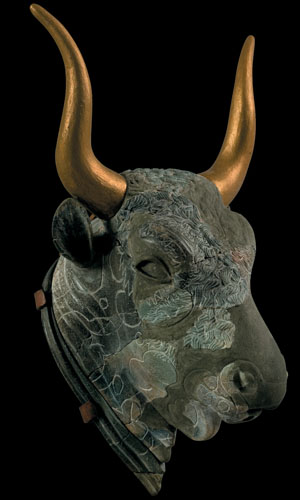
I wish I could get to New York this summer and see this fascinating exhibit of Minoan artifacts at the Onassis Culture Center. The Minoan civilization has intrigued me all my life and I'm always excited to see Minoan art. I hope to visit Crete in the next few years and see the ruins in person. A friend of mine pointed out that much of the sites you visit in Crete are mostly reproductions but I can't help but long to see them anyway. I found this Late Minoan 1B (ca. 1450 BCE) carved chlorite bull's head with gilded horns from Zakros exquisite!

"An important new exhibition, From the Land of the Labyrinth: Minoan Crete, 3000-1100 B.C., has just opened at the Onassis Cultural Center in New York. It brings more than 280 artifacts from Crete--from a miniature gold double-ax to a four-foot-tall storage jar, from wall paintings to carbonized figs--most of which have never been shown abroad before and some being displayed for the first time ever. On loan from the archaeological museums of Herakleion, Khania, Rethymnon, Haghios Nikolaos, Ierapetra, Siteia, and Kissamos in Crete, the artifacts are arranged in 11 thematic sections intended "to reveal aspects of daily life in the Minoan civilization--including social structure, communications, bureaucratic organization, religion and technology--during the third and second millennia B.C." The first solely Minoan exhibition in the United States, From the Land of the Labyrinth is a great overview of the civilization and its achievements.

Some of the small terracotta figurines on display have a seemingly playful character, such as double-headed (push me, pull you) bull and a rather large dung beetle. But the bull is a votive offering from Vrysinas, a mountaintop sanctuary, and many two-headed bulls were found there. (The exhibition catalog notes that by adding a second head, the donor of the votive might have emphasized the importance of the request being made to the divinity.) The beetle, from the open-air sanctuary of Piskokephalo, is another votive and recalls the Egyptian scarab.

Two of the most intriguing finds on display are sistra, Egyptian rattles, found at excavations on Crete. One, made of bronze and found at Mochlos, is dated about 1450. The other is one of six terracotta ones that accompanied burials in a cave at Hagios Charalampos that are substantially earlier, ca. 2100-1700 B.C. The exhibition catalog notes that "the sistra constitute undeniable evidence for a strong relationship between Crete and Egypt and of the influences exerted by Egypt on Minoan civilization." Other reminders of links between the Minoans and Egypt in the exhibition include the beetle votive figurine already mentioned and a scarab of the 18th Dynasty pharaoh Amenhotep III from Kastelli, Khania.

A highlight is the well-preserved boars' tusk helmet from Armenoi, only the second such helmet found in Crete. Shown alongside it are two miniature representations of men wearing boars' tusk helmets. Both of these (one of hippo ivory and one of bone) would have been attached to a furnishing of some sort. All three date within 1375-1250 B.C. In an adjacent case is a large Late Minoan II (1450-1400 B.C.) jar on which boars' tusk helmets are used as the chief decorative motif. So, we have the full range of actual object, use of the object as a decorative plaque, and reduction of it to a motif that perhaps conveyed a sense of prestige.

If you enjoyed this post, never miss out on future posts by following me by email!

Wednesday, August 29, 2007

Theseus and the Minotaur retold with Machinima Software iClone 2.1

I've been exploring Machinima Software, which is software to produce 3D animated films on just a consumer-grade computer, and found this excellent example of using animation software to retell a classic story of Greek mythology - Theseus and the Minotaur.

If you enjoyed this post, never miss out on future posts by following me by email!