My husband and I have been watching the "Qin Empire Epic", a Chinese produced series, on Amazon Prime. Although I can't always keep up with the subtitles (I can't read that fast from across the room!) I have found the history of the unification of China under Qin Shi Huangdi, initially called Yíng Zhèng, very interesting. Most references to China's first emperor that I had read, mostly information accompanying the three different Terracotta Warriors exhibits I have attended, seemed to emphasize the emperor's brutality, as portrayed in traditional Chinese historiography. But, I discovered, like Roman propaganda vilifying the emperor Nero, perceptions of Yíng Zhèng's actions need to be considered in the political context of the fierce competition between warlords that dominated the tumultuous Warring States Period.
Although I haven't seen any reference to burying Confucian scholars alive yet (we're on episode 78), I was researching some of the portrayed events and found that recent research suggests that the "burying of the Confucian scholars alive" tale, one of Qin Shi Huangdi's most heinous reported acts, is now considered a Confucian martyrs' legend. It is based on an incident where the emperor ordered the execution of a group of alchemists who had attempted to mislead him. But later, during the Han dynasty, Confucian scholars, who had served the Qin loyally, used that incident, claiming the alchemists were Confucianists, to distance themselves from the failed dynasty and ingratiate themselves to the new administration. So, just like in the west, tales of martyrdom were apparently used for political manipulation.
Reassessments of Qin Shi Huangdi's rule in more modern times seem to oscillate between the traditional view and a perception of the first emperor as a hero of Chinese history. In Hong Shidi's biography "Qin Shi Huang," published by the state during the Maoist period, the first emperor is portrayed as a far-sighted ruler who destroyed the forces of division and established the first unified, centralized state by rejecting the feudal past. He was criticized, though, for not being as thorough as he should have been, in crushing counter-revolutionaries which resulted in hidden subversives under the leadership of the chief eunuch Zhao Gao seizing power after the emperor's death and using it to restore the old feudal order. His famous quest for immortality, so widely acclaimed in exhibit literature, was scarcely mentioned (and hasn't been in this Prime series either so far). The series does portray the emperor as occasionally short-tempered and impulsive, even stubborn, however, although ultimately he is seen willing to reconsider some of his more drastic edicts if provided with convincing argument.
As a Roman history enthusiast, what I find totally astounding about the Warring States Period is the sheer number of combatants reported in the battles. These events coincide roughly with the Second Punic War in the west. Military engagements during the Warring States Period in the east are described as involving hundreds of thousands of soldiers on each side. In fact, during the series, one state boasts of being able to supply over one million soldiers. In contrast, at Cannae, according to Polybius, the Romans fielded 86,400 infantry and cavalry and Hannibal's Carthaginians only 50,000 and it is considered to be one of the largest engagements during that conflict. By the time the decisive battle of Zama was fought, the Romans fielded less than half that number.
I told my husband that the Romans were really fortunate the Chinese "world" did not encompass them at the time!
 |
| Reproduction of Terracotta Warrior "painted" with colored light to illustrate how the figure once appeared before being interred in the tomb of Emperor Qin Shihuang in 3rd century BCE China that I photographed at the "Terracotta Warriors of the First Emperor" exhibit at the Pacific Science Center in Seattle Washington. |
 |
| A Qin Dynasty terracotta warrior from the tomb of Chinese emperor Qin Shi Huang 210 BCE that I photographed at The Field Museum in Chicago, Illinois |
 |
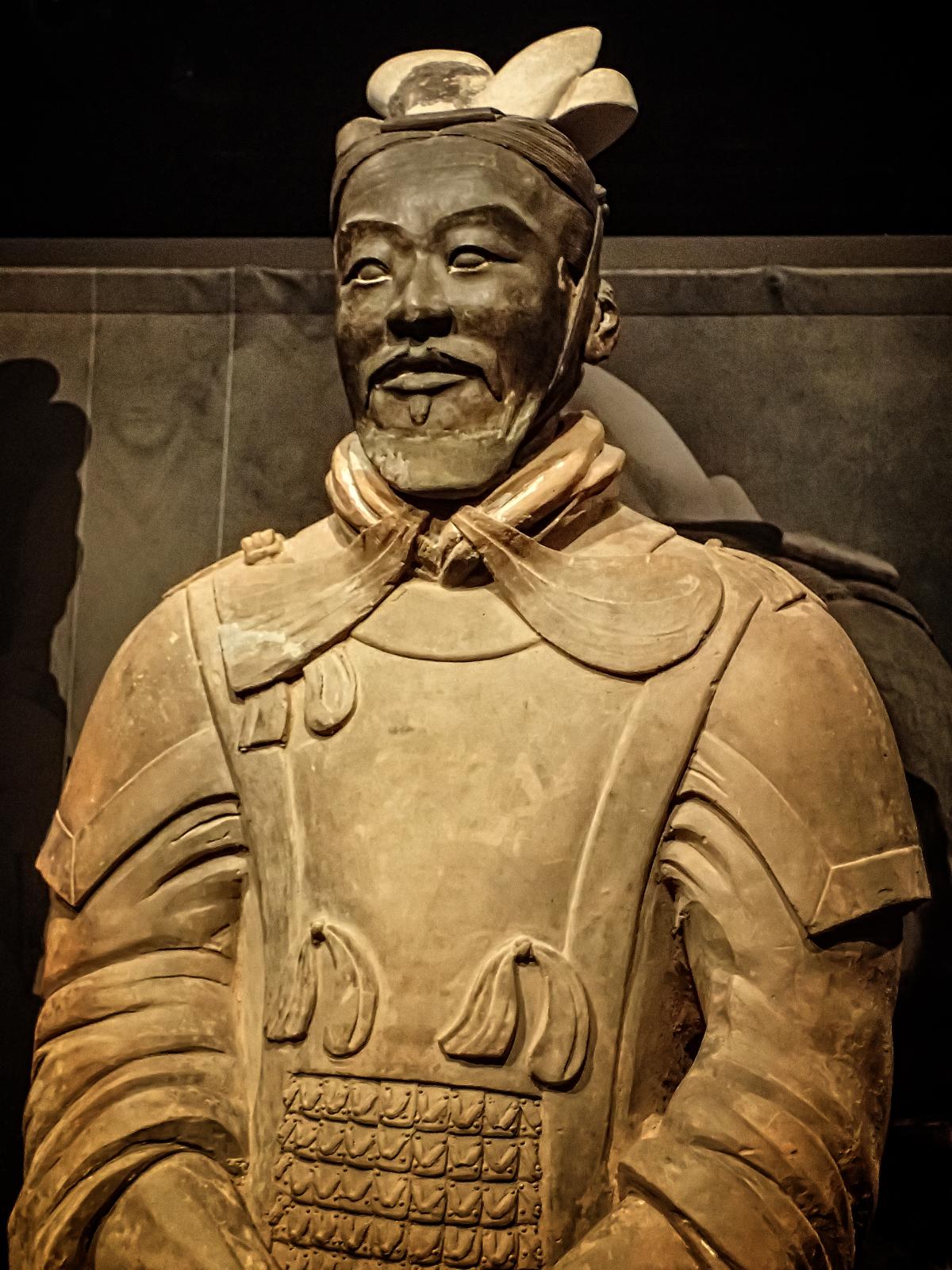
| Terracotta Commanding General from the tomb of Emperor Qin Shi Huang China 210-209 BCE that I photographed at the "Terracotta Warriors of the First Emperor" exhibit at the Pacific Science Center in Seattle Washington. |
 |
| Closeup of a Terracotta Qin archer's braided hair from tomb of Emperor Qin Shi Huang China 210-209 BCE that I photographed at the "Terracotta Warriors of the First Emperor" exhibit at the Pacific Science Center in Seattle Washington. |
 |
| Model of workers assembling the terracotta army for Emperor Qin Shihuang's tomb in the 3rd century BCE that I photographed at the "Terracotta Warriors of the First Emperor" exhibit at the Pacific Science Center in Seattle Washington. |
 |
| Model of workers assembling the terracotta army for Emperor Qin Shihuang's tomb in the 3rd century BCE that I photographed at the "Terracotta Warriors of the First Emperor" exhibit at the Pacific Science Center in Seattle Washington. |
 |
| Bronze Goose found in the tomb of Emperor Qin Shihuang Qin Dynasty China 221-206 BCE that I photographed at the "Terracotta Warriors of the First Emperor" exhibit at the Pacific Science Center in Seattle Washington. |
 |
| Model depicting workers assembling a terracotta horse from the tomb of Emperor Qin Shi Huang China 210-209 BCE that I photographed at the "Terracotta Warriors of the First Emperor" exhibit at the Pacific Science Center in Seattle Washington. |
 |
| Stone armor from the tomb of Emperor Qin Shi Huang China 210-209 BCE that I photographed at the "Terracotta Warriors of the First Emperor" exhibit at the Pacific Science Center in Seattle Washington. |
 |
| Replica of a 2-ton bronze chariot from the tomb of Emperor Qin Shi Huang China 210-209 BCE that I photographed at the "Terracotta Warriors of the First Emperor" exhibit at the Pacific Science Center in Seattle Washington. |
 |
| A terracotta cavalryman and his horse from the tomb of Emperor Qin Shi Huang China 210-209 BCE that I photographed at the "Terracotta Warriors of the First Emperor" exhibit at the Pacific Science Center in Seattle Washington. |
 |
| Bronze tiger-shaped weight from the Warring States period China 475-221 BCE BCE that I photographed at the "Terracotta Warriors of the First Emperor" exhibit at the Pacific Science Center in Seattle Washington. |
If you enjoyed this post, never miss out on future posts by following me by email!