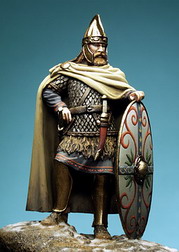
I watched a very interesting two-hour program about the Sahara and the history in that region on History Channel International yesterday. I was particularly interested in the segment about a Berber warrior queen that arose during the late 7th century to lead her people against invading Arabs in 669 CE. It's been many years ago that I read a book entitled "Warrior Queens" by celebrated historian Lady Antonia Fraser. I learned about several female warrior leaders in that book that I had never encountered before but even Lady Fraser seems to have overlooked Al Kahena.
[Image - Berber Woman, Emile Vernet-Lecomte, French, 1870]
I was able to find this interesting article about Dahia Al Kahena on the web though. An abstract:
"According to Arab chroniclers of the time, Kahena was half queen and half sorceress with dark skin, a mass of hair and huge eyes. When she was angry or possessed by her demons, her eyes would turn red and her hair would stand up on end. The chroniclers may have had an interest in painting a fiendish image of this woman. Yet such propaganda may have done more to contribute to her reputation as a fearsome opponent. Kahena amply demonstrated her fiery mettle when, in 696, she led a Berber force which routed an Arab army in the plains below the Atlas mountains spanning modern-day Algeria and Tunisia. So numerous were the Arab casualties that Arab chroniclers renamed the wadi where the battle took place as the `Valley of Disaster'. Like a latter-day Boadicea, or a precursor to Joan of Arc, this female warrior this female warrior was proving a troublesome enemy to the invaders.Legend may have grown around Kahena, but she was an all-too-real opponent for the caliphs forces. She proved utterly ruthless in conducting a guerrilla war of harassment. She adopted a scorched earth policy by having all the standing crops destroyed in order to deprive the Arab army of any sustenance from the land. This act, however, aroused resentment among settled tribes, who sent emissaries to the Arab commander asking him to come to their assistance.
In 699 the caliph, tired of the interminable struggle, decided to strike a decisive blow. He sent into North Africa the largest army ever seen in the region. The force was made up of Arab troops reinforced by thousands of Berbers who had turned against Kahena."
Like Boudicca, Al Kahena's revolt ended in a slaughter although her final battlefield was the huge colosseum built by the Roman emperor Gordian at the trading crossroads of Al Jem. However, she did not take her sons with her into death but ordered them to go to the Arab commander and offer their service. They were accepted into the caliph's service and later became outstanding leaders in their own right.
According to Wikipedia, her sons' acceptance was accomplished by an Arab officer that Al Kahena had captured early in her career and adopted.



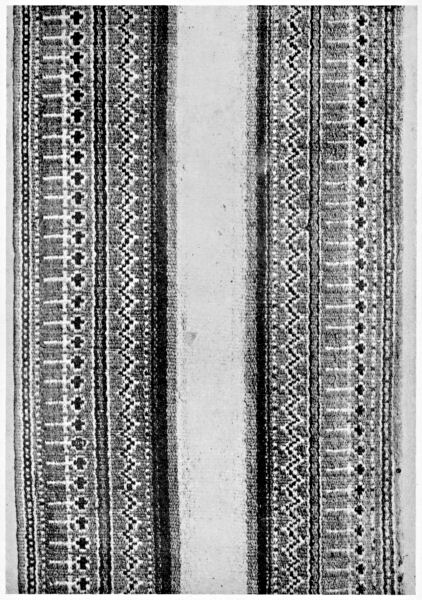

 In a dusty cave in Israel,
  For the UCLA students, exploring the sprawling agricultural settlement that was Karanis and uncovering plant remains and animal bones from the fourth through sixth centuries is turning into the trip of a lifetime.
 The Phoenicians, enigmatic people from the eastern shores of the Mediterranean, stamped their mark on maritime history, and now research has revealed that they also left a lasting genetic imprint.
 This article naturally caught my eye as I am currently listening to Conn Iggulden's first novel in his trilogy about Genghis Khan and have found it both thrilling and fascinating. It is historical fiction but hopefully Iggulden has not strayed too far from the facts. His incarnation of "Timujin" is a warrior of admirable strength and skill as well as a man of vision and deep conviction. Some may also perceive him as ruthless although I think he demonstrated more restraint than other men spawned in such an environment. The tribal society Iggulden depicts on the unforgiving steppes is that of a hard people struggling often just to survive in a land where the dispossesed or just unfortunate are prey to any passing group who simply want their meager belongings even if they are just an old worn dell (coat) and a small pouch of rancid mutton. But it was from these very wanderers that Genghis Khan forged a nation.

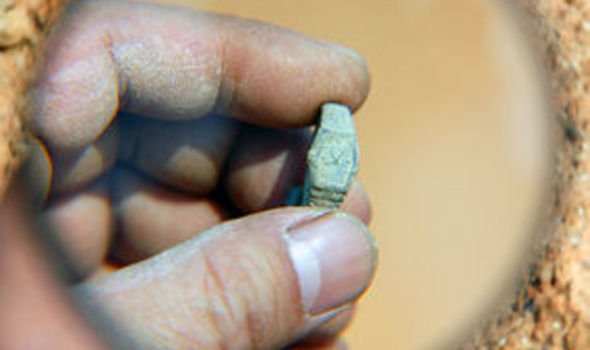
 In the stratum associated with the disruption, they found an Egyptian scarab from the eastern Nile delta and an amulet linked to the Egyptian goddess Mut.
 Below the Old City walls in Jerusalem there is a ravine that begins as a gentle, grassy separation between hills, but then quickly descends south into the rocky earth. Eventually, the ravine becomes a steep, craggy depth, scarred on the far side by shallow caves and pits that vaunt hollowed-out chambers and narrow crypts.
  ARCHAEOLOGISTS are racing against time to salvage a fortune in coins and items from a 500-year-old Portuguese shipwreck found recently off
 Receding Alpine glaciers have uncovered a trove of ancient artifacts in recent years. Last month, Swiss archaeologists announced that they had dated some of the items to as far back as 4500 B.C.E.--1000 years before the famous Iceman.
 Archaeologists in Peru say they have discovered the jawbone of a fetus among the remains of a sacrificed woman in a pre-Inca tomb, suggesting the Lambayeque culture practiced the atypical sacrifice of pregnant women and their children.
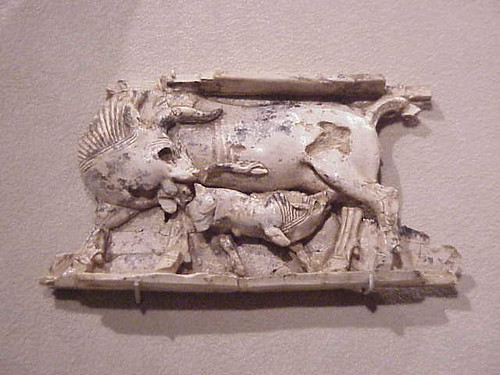
 A treasure hunter's fantasy - bronze sculptures, intricate ivory
 The
The